 Horus
How to raise your first VC round when your dad doesn't work at a VC
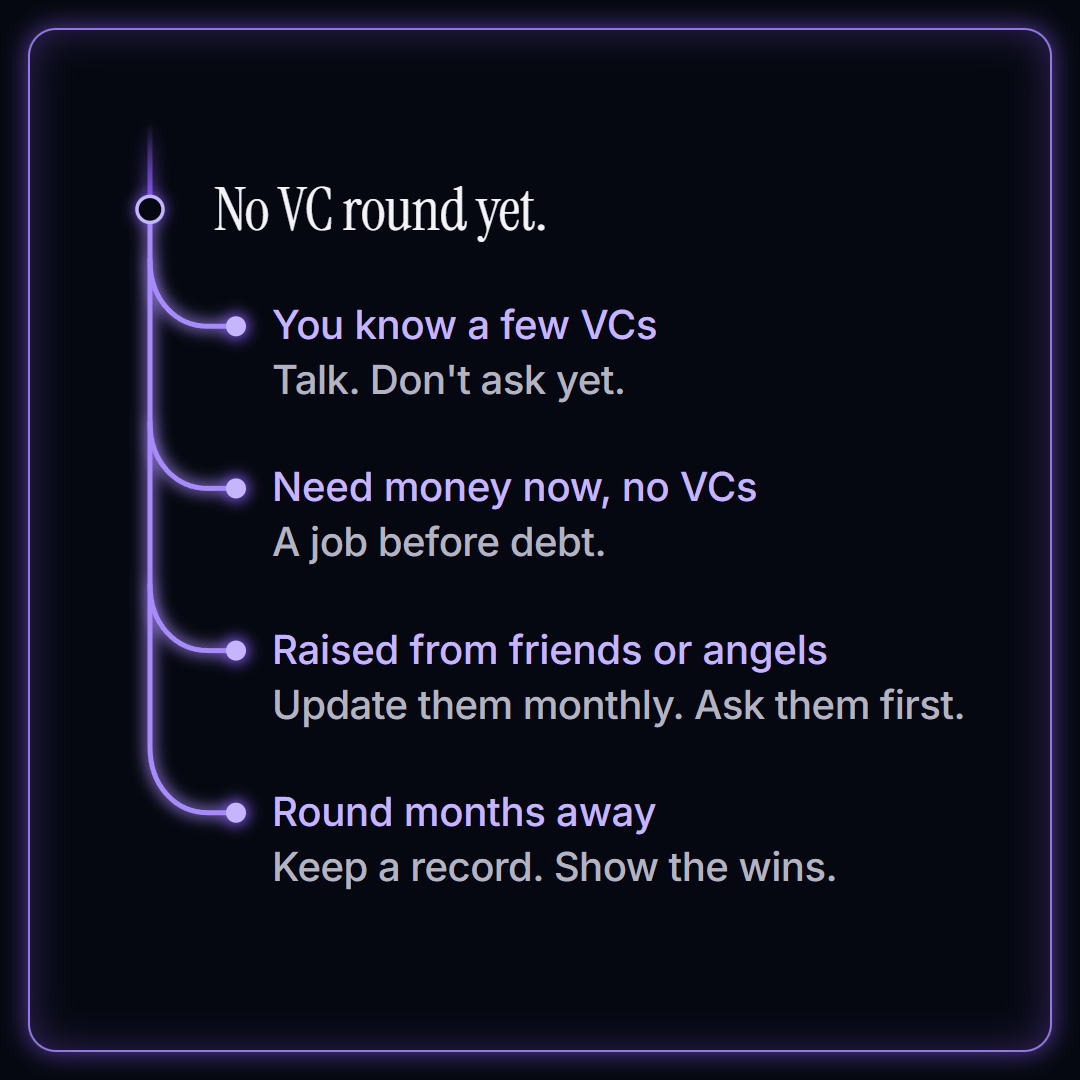
No VC round yet. Maybe nothing, maybe some money from friends, angels or a grant.
In short
A VC you met for ten minutes at an event doesn't know you. Talk to the VCs who do, and leave money out of it. Raise as late as your runway allows, never with three or four months of money left.
A lot of founders tell me they're talking to investors. That can mean fifty things. Often it means ten minutes with a VC at an event, and a week later it's "we have interest".
About two in three founders we talk to had raised some outside money before they came to us, and the rest hadn't raised from anyone yet.
The first round with a fund is the least rational one, so it depends more on the founder, and on who really knows them, than any round after it.
Do you really know the VCs you plan to ask
Say you leave a job to start a company. A firm your old employer worked with is more likely to buy from you than from a stranger. Investors work the same way.
That's how a team with less traction sometimes raises a much bigger round. The investors already knew them. A study of US venture deals from 2000 to 2020 found that a third of them had a founder and an investor from the same university, and those deals were about 18% bigger on average.
A parent at a fund, or a college friend who became a partner, is the easy version of this. Most founders don't have it.
A VC you met for ten minutes at an event doesn't really know you yet.
The VCs who really know you are people you've worked with, or friends. I have investors I'm friends with. Work brought us together, but I like them as people, and if they need something from me, I help.
I don't like how people talk about building relationships, like scoring points in a game. Give a VC this, then that, then ask for money. That treats something irrational as a system, and friendship doesn't work like that.
Your first investor can also be a friend, family, someone you've worked with, or a partner at a fund who happens to be your friend. That money comes without a long process and weeks of diligence. People call it non-strategic, because it mostly gives you money and little else.
How to talk to the VCs you know before you raise
The VCs who know you will be nice to you. People always pat you on the back.
Knowing a VC gets you a meeting. It doesn't mean they'll invest, any more than having two legs puts you in the Olympic 100 metres.
So talk to them and leave money out of it. Tell them you're working on a project and you're not raising yet, and ask how they see your niche.
"working on something new. not raising yet. curious how you think about [niche]. what would you look at in a project like this?"
Say it only if it's true. If you're raising in the next few weeks, it's an ask, and Why some rounds never close covers that.
I'd undersell what you have, and I wouldn't marry their advice, because this early the project will still change.
What to do if you need money now and know no VCs
Money gives you a better chance of making it, at the earliest stage too. I mean runway, whoever's money it is.
Plans beyond a few months rarely hold. Everything costs more and takes longer than you planned.
If you're already short of money, take a job before you take on debt. Loans and credit cards add stress you don't need. Taking a little more from your investors is a different thing, and it comes up below.
If you still want investors, start with the non-strategic money above. Local programmes and incubators can help too, and some give grants you don't pay for with shares: the EU and universities fund research, and in crypto some blockchain foundations fund projects built on their networks. The amounts are small and slow to arrive, so apply before you run out.
If none of that is open to you, I think there isn't much you can do.
Keep two questions apart, though: how you get through the next months, and how the product does. A job can keep you going while the product waits.
If you already raised from friends, angels or a grant
To me, money from friends, family or angels is a green flag. It shows you know people who back you.
But a fund will discount money from friends and family, because they backed you as friends. The same goes for anything that wasn't strategic, and small money doesn't count at all. A fund looks at what you did with it.
With a grant, a fund will look at what it paid for. If it funded research, by your next round the research should be done and the product built up to that point.
Keep your investors close
Your friends and angels are the first people to talk to about your next round. Send them an update every month in the same format. Pick your numbers and report them every time, bad months too, without making them look better than they are.
It's hard when the numbers jump around month to month. But you don't want your investors to forget about you after three months of silence.
Funds you haven't raised from see the wins. The last section covers how to tell them about mistakes.
Ask them before anyone else
When you're close to opening the next round, write to them first. Tell them where you are and why another round could take you much further. Then ask three things.
"thinking about our next round. after [what you've done since they came in], we think another round could take us a lot further. what do you think? how do [these terms] sound to you? and do you know anyone who could lead it?"
It's a question about money, so send it only when you're ready to open the round.
They should want in too. Most won't lead it, though. On our calls, 10 of 14 founders who told us about their earlier investors had investors who wouldn't lead the next round.
They can still bring you the fund that leads. A fund that's already in may not lead either, but it can bring you the lead.
When you need a little more
If you need a small amount to reach your next milestone, take it from the people already in, as an extension of your last round. Only do it to reach a milestone that changes the round. If your investors can afford it and still say no, something is wrong.
I'm not a fan of taking a bridge round to new funds, because it always looks like you're stuck.
Do VCs really invest in the team at pre-seed
At the very start, mostly yes. The project will change, so the main thing a fund can bet on is you.
Later that changes. The later the round, the more rational the decision, and a lot of questions about traction and the market are normal. When a fund tells you it looks at the team, that's also in its interest. It sounds supportive and looks good on the website, and it can be true as well.
Even in the first round, a fund will want some proof. Most founders we talk to lacked it, and few named it as their problem. They said money or access, or that it was too early to think about proof.
Write down what a fund would need to see for this round, and what you have. How much revenue do you need to raise a seed covers which proof holds up when a fund checks it.
How to prepare if your round is months away
If you have time, use it to keep a record. Write down what you try, what changes and why. And measure it.
Most founders don't, so two months later they've changed what they say, because someone told them to or something seemed to work, and can't tell whether it helped. Without numbers you can't tell whether the old way failed or the new one works better.
About four in ten of the founders we agreed to talk to again later are waiting for proof that doesn't exist yet: a launch, first paying customers, revenue. When it comes, the record is how you show it.
The funds you haven't raised from should see you win. That's why I'm not a fan of building in public. After the exciting start, momentum always dips, and then you just grind. Investors shouldn't watch that part.
Tell funds about your mistakes after you've fixed them, with the numbers since.
"when we started we thought [x]. we tested it with [customers] and learned [y]. since we changed it, [number]."
Said like that, a fund hears that you were wrong, fixed it, and now have much better numbers. If you tell them at the start about a thesis you haven't checked, and two months later they learn it was wrong, it reads very differently.
In a call, still say what you haven't proved yet.
Then raise as late as your runway allows. The later you raise, the more you can show, so the stronger your position and the less of the company you give away. That's harder if you build rockets, but even there waiting gets you more proof you'll build them. Raising earlier usually means a lower valuation, and What valuation should you raise at says when that's worth it.
Just don't open the round with three or four months of money left. From what I've seen, it takes three weeks to three months from the first meeting with a fund to the money.