 Horus
Horus What can still blow up your round after a VC says yes
A fund said yes, and nothing's signed yet.
In short
Until the papers are signed, either side can still walk away. Push back on anything that touches ownership. I wouldn't run to every fund with a yes until it's signed.
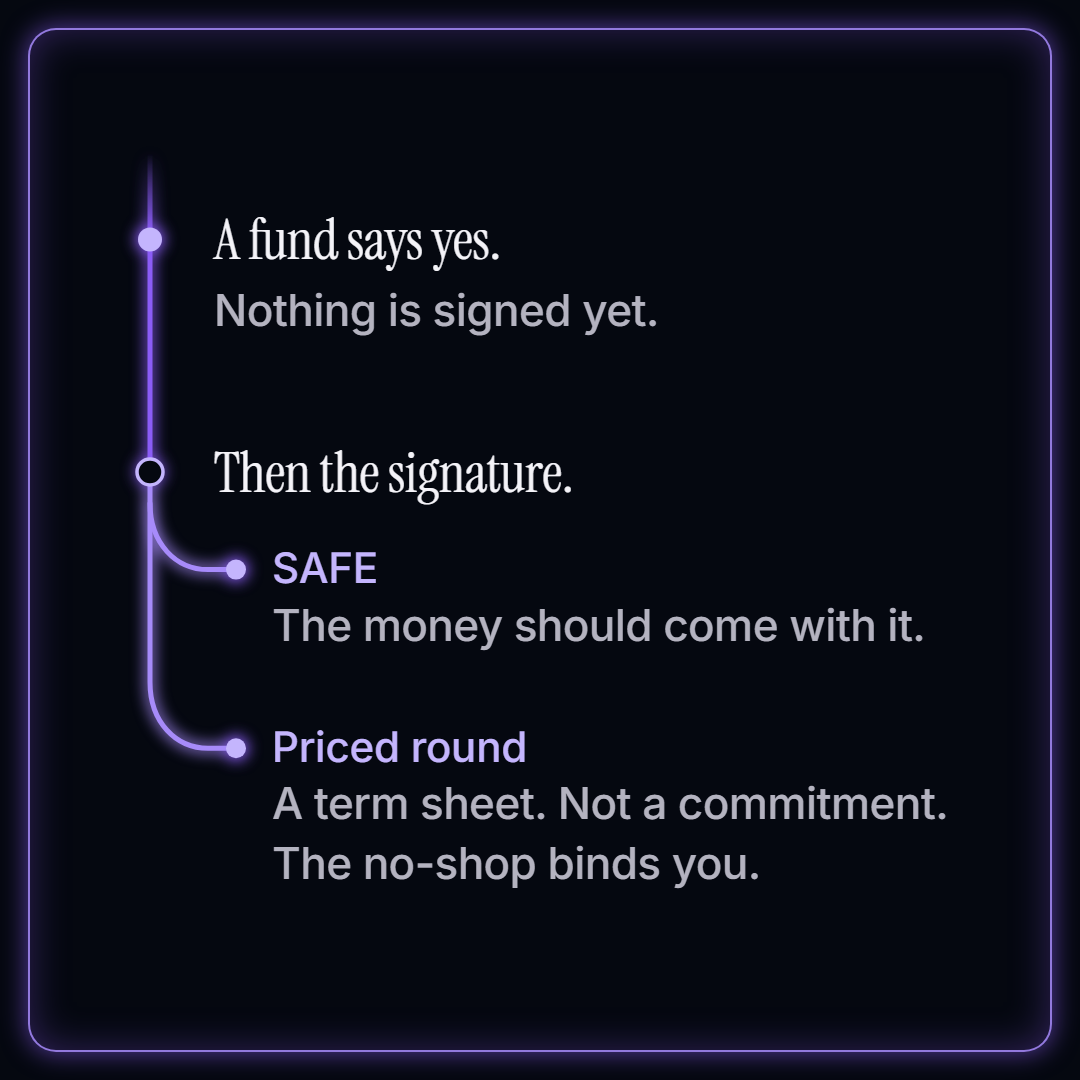
A yes on a call or in an email doesn't commit anybody. Until the papers are signed, either side can still walk away. On a SAFE, the papers are the SAFE itself. On a priced round, it's the closing documents that come after the term sheet.
You might walk away over the price or the terms. And the fund might find something it doesn't like when it looks closer. A logo that still belongs to your designer can be enough to stall a round.
Most of what a fund can find was in the company long before your first call. I'd fix as much of it as you can now. If no fund has said yes yet, you have more time to do it.
When a low VC offer can hurt your next round
A yes can still blow up on the price. A low offer hurts when taking it leaves too little of the company to sell to investors in your next round.
You always need a floor, the lowest valuation you'd take. A low offer is when you use it. What valuation should you raise at shows how to work yours out, and what to do when an offer comes in under it.
I've heard about some very low offers from founders I've talked to. I think some investors make an offer like that to see what happens, in case you say yes. I know others use it to open a negotiation. The founders I heard it from knew straight away they couldn't take it. They didn't know what to do next.
Ask how they got to the number. The answer usually tells you whether they're testing you or opening a negotiation. If the offer tells you they don't respect you, or don't believe in the company, I wouldn't go any further, even if they raise the number later.
If it's above your floor and still lower than you hoped, ask yourself what you want. Say you plan to sell the company early, and you've found an investor who understands that. Then you won't need room for round after round. So a lower price can be fine.
Raising before launch is another time a lower number can be worth it, as What valuation should you raise at says.
If neither of those fits you, or the offer is under your floor, say no to the price and name yours. A very low price doesn't help the investor either. They need your next round to happen too.
"thanks for this. it's below what we're raising at, and we want room for the next round. could you get to [your number]?"
If they won't move, you can still split the round in two. Take the first part now, at your floor or above, and the rest after your next milestone at a higher price. Why some rounds never close shows how.
Which terms to push back on before you sign
Say you agree on the price. Bad terms can hurt you a round later. You accept something about ownership because the money is right in front of you. Then it comes back at your next round.
So push back on anything that touches ownership until you're comfortable with it today. You won't feel any better about it next time.
I'm extra careful about this one. I've seen a lot of founders say "eh, whatever, let's sign" the moment the money was in front of them.
If it's the standard SAFE
A SAFE is YC's short contract where the investor's money turns into shares at your next priced round. The other way to raise is a priced round, where the fund buys shares at a set price. You sign a term sheet first, a short paper with the main terms of the deal.
Most of the early rounds I see use YC's post-money SAFE, and in my view the normal form is fine. There's nothing strange in it, and YC's own guide says the cap is usually the only thing you negotiate. The cap is the highest valuation your SAFE converts at when it turns into shares.
The form even has a line where you both confirm you haven't changed it except to fill in the blanks. If that line is missing, something has been changed. Even when it's there, compare what you're sent with YC's template.
If anything is added on top
Anything added should work for both sides. Your success is often your investor's success too, but not always, so read every extra line. I'd watch two things most. One is preferences, the rules on who gets paid first if the company is sold. The other is extra obligations.
On preferences, the SAFE already gives the investor a 1x preference. If the company is sold early, they get back what they put in before you get anything.
So watch for anything above 1x, where they get back more than they put in. Or participation, where they get their money back and then a share of the rest as well.
In priced rounds, 1x and non-participating is close to standard. The law firm Cooley looked at the 166 deals it worked on in the second quarter of 2026, from seed to Series D and later. In 95.8% of them the preference was 1x, and in 96.4% it was non-participating.
On a priced round, also check the option pool, the shares kept for future hires. The lead, the fund setting the terms of the round, often asks you to make it bigger before the money goes in. The new shares usually come out of the founders' part.
On obligations, look at the side letter, a short extra contract signed next to the SAFE. YC says most side letters ask for regular updates on your numbers, called information rights, or for a seat at your board meetings without a vote, called an observer seat. Read what each one makes you do, and be careful with anything that asks for more.
Pro rata touches ownership too. It's the right to put more money in at your next priced round to keep their share. YC publishes a side letter for it and still tells founders to consider it carefully, because it can shrink your share more than you expected.
A common way to limit it is to give it only to investors who put in at least a set amount. For anything else, ask what it's for.
"what does this add to the standard safe, and why do you need it?"
What a fund checks in due diligence
While you weigh the price and the terms, the fund checks that the company is what you said it is.
Who owns your IP
The funniest delay I've seen was a logo. A designer had done the logo and the branding, and the contract never moved the copyright to the company. The lead was ready to invest. When the team asked the designer to sign the rights over, the designer stopped replying.
I still don't know why. The round sat stuck until they found a way around it.
Everything the company runs on has to belong to the company: the code, the name, the logo, the domain. That's your intellectual property, or IP. Your SAFE even has you confirm that the company owns the rights it needs, or can get them, as far as you know.
A priced round goes further. The model term sheet from the US National Venture Capital Association (NVCA) asks every founder, employee and consultant, past and present, to sign their rights over.
So get everyone who built something for the company to sign it over now. That means founders, your past team and outside help like that designer. If somebody won't sign, you may have to rebuild what they made.
How your cap table is split
I've also seen a fund look at a cap table, the list of who owns what share of the company. The split was so bad there was no chance of another round. That put everyone in a bad mood.
Work out who would own what after this round and the next one. If the founders would end up with too little, fix it before this round closes.
Anything in court
If you've had a lawsuit or a court ruling, or a case is still running, have the documents ready before the fund asks. Add a short note on where it stands and what it means for the company.
Where the money went
A fund will go through your spending. If it finds you spent too much on the team's own pay, it can stop right there. Know how much you've paid yourselves so far, and why.
A lead will also ask what you'll each pay yourselves from the new money. It's easy to agree on everything with your cofounder while there's no money. I haven't seen cofounders fight over it, but I'd still agree on it before a lead asks.
When a VC can still back out after saying yes
If those checks find a problem, the fund can still stop the deal. I've heard stories of funds saying yes and then going quiet. On a priced round, a fund can back out even after you've both signed the term sheet.
On a SAFE it's simpler. The money is meant to come with the signature, since YC's form has the investor paying on or about the date of the SAFE.
A priced round starts with a term sheet, and you both sign it. The NVCA's model says it still "is not a commitment to invest". The deal depends on the fund being happy with its financial and legal checks.
In that model, only two parts are binding: confidentiality and the no-shop. Both are promises from you and your company.
The no-shop means that for a set number of days you don't look for other offers. If anyone else gets in touch, you tell the investors on the term sheet. You can share the terms only with funds the lead accepts, and other investors come in only if you and the lead agree.
So before you sign, check how long the no-shop runs, and agree with the lead which other funds can still come in.
When to tell other VCs that a fund said yes
Once a fund says yes, you'll want to tell the others. Say you tell every fund you're talking to that one fund said yes, and then that fund doesn't sign. That looks really bad. The next fund knows somebody spent weeks digging into you, put in time and energy, probably paid lawyers, and then walked away. They'll want to know what that fund found.
I wouldn't run to every fund with a yes until it's signed.
On a priced round it works differently. You can keep talking to other funds until you sign the term sheet. After that the no-shop decides who you talk to, and the funds you and the lead agreed on come in on the same terms.
In Why some rounds never close I said to tell the other funds about your first yes and give them all one date, two weeks away. By a yes I meant a signed one. On a SAFE, a yes usually gets signed in a week or two, sometimes three. It takes longer if diligence finds something.
So on a SAFE, ask the fund that said yes what it needs from you to sign, and by what date. Ask too whether you can name it once it signs. Keep the signing date between the two of you.
Once the SAFE is signed, give every other fund one date, two weeks from the day you tell them. If the signing takes longer than you agreed, ask what's left, and give nobody else a date until it's done.
Waiting costs you little, because you keep talking to the other funds until the money is in your bank. If one asks whether anyone's in, keep it general.
"still talking to a few funds. when we set a date, everyone gets the same one."
To give them that date, send one line to every fund you've been talking to, including the investors who couldn't lead. If the fund that signed doesn't want to be named yet, leave the name out.
"[fund] signed today for [amount] at a [cap] cap. decisions by [date]. if you want in, tell me by then."