 Horus
What to do when a VC says let's talk next round
The calls went fine, and the funds either told you to come back next round or went quiet.
In short
When a VC says let's talk next round, they don't believe in you yet. Treat it as not yet, send them real wins as they happen, and don't promise a future you can't show by the time you come back.
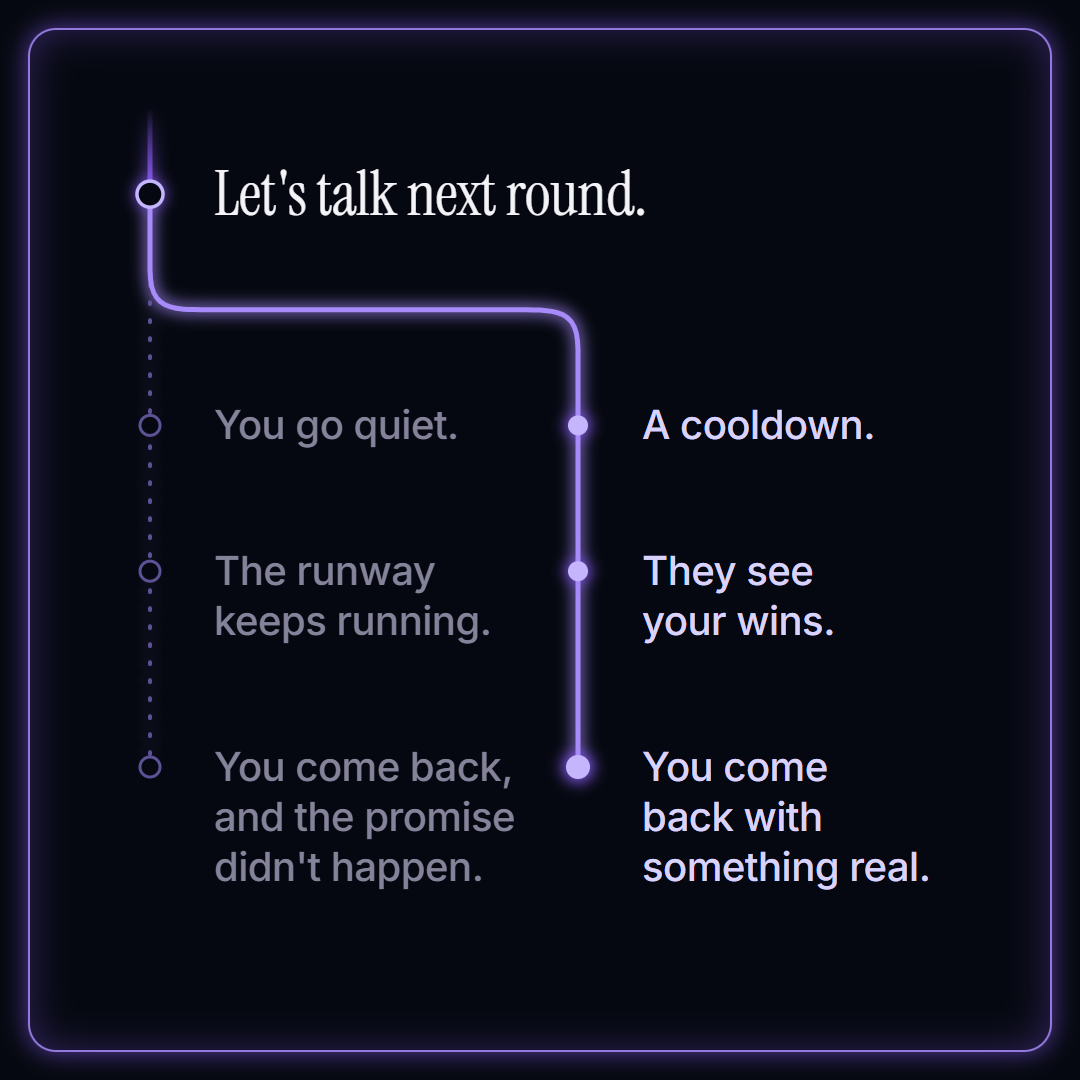
When a VC says "let's talk next round", they don't believe in you yet. Treat it as a "not yet", keep sending them real wins, and leave time between them. It usually goes wrong when you burn out, go quiet for a few months, and come back with a promise that didn't come true.
A "let's talk next round" is hard to read, because funds rarely tell you straight that you're too early. They say "cool, thanks for the call, if there's a next round let us know", or they ghost you and watch from the sidelines. Either way, what they're missing is conviction, and for that they need traction, a team and some proof that somebody cares.
Does it mean no when a VC says keep in touch
A generic "keep in touch", a no with a specific reason and a ghost all mean "not yet", until the fund invests or blocks you.
If a fund could invest and doesn't, it has chosen not to, for now. That's how it works, and it's fine. So even if the fund never writes back, keep it on the list of people who hear your wins. A fund that passed is a free call option at this point. The only cost is a message when there's a win to show.
One thing does change while your round is open. It has a deadline, the one from Why some rounds never close. A fund without a yes by then is out of that round, but it still hears your wins, just without an ask. Going back with a new ask is a different move, and I covered it in Nobody passed and nobody moved.
How to take hard feedback on a VC call
A pass takes the pressure off, and once you've said you won't push, it's a good moment to hear what a fund really thinks.
Everyone says they love direct feedback, but only when it's "send me the wire details". When it's a no with a reason, I see founders take offence and end the call.
That's your monkey brain. It wants to fight, and that's normal, as I wrote in What stands between a good VC call and money in the bank. But if you get up and leave, you've wasted that moment yourself.
Funds hold back their real view for a reason of their own. They're afraid you'll use their answer to push them into a deal they don't feel today. So say out loud that you won't push, then ask about whatever they flagged.
"understood, i won't push. if something materially changes, would you want to hear about it? and out of curiosity, what did you make of [the part they flagged]?"
They'll say yes to hearing more, because it costs them nothing. If they flagged nothing, ask what they made of the market. The same script works when the pass comes by email.
Should you stop fundraising after too many nos
If you stop asking for money for a while, don't go quiet, because the runway keeps running while you're out.
You hear "no" and "not now", call after call, and nobody shows any conviction. Maybe you opened the round too early. You burn out on it and decide to stop raising and stop talking to people for a while.
Stopping the raise and going quiet are two separate decisions. If nobody's in by your deadline, stop asking and keep talking. When you're burned out, the talking is the part that's easy to drop.
A pause can work when it's tied to a launch the funds told you they want to see. Then you go back to them with the launch and a date for the round.
If you're about to drop both only because you're tired, first do the runway math in How to lose your round in one call. Three or four months from now you'll want to go back to those funds with something to show.
What happens when you go back to a VC and the plan didn't happen
If you told a fund about the future and it didn't happen, coming back indirectly admits that you lost.
I've seen this several times in the last few months. On the first call you say "we'll do these things, and then we'll raise", or "we're going to do big things, so you should invest now". Then you come back, and those things didn't happen. Four months are gone, and you have less money and a smaller selling point, because the thing you promised played out against you.
It happens because everything takes longer than you think. In one study, students finishing a thesis expected to need about 34 days on average and took more than 55. Fewer than half finished even by their own worst-case date.
So talk about what has already happened, and put a margin into any date you give, because it will land later than you expect. And pick your moment. The best time to talk to an investor is right before a win, so they see what you told them come true within weeks.
"[x] is live and [y] is signed. next is [z], by [month]."
The same goes for the script from Why some rounds never close: "we're not raising yet. we'll open the round when [milestone]". Name a milestone you're already close to, and come back once it's done.
If you've already promised something that didn't happen, wait until you have a win to show. Then tell them what happened and show the numbers since, as I wrote in How to raise your first VC round when your dad doesn't work at a VC.
What counts as a material change for a VC who passed
A material change cuts both ways: a big validated launch moves a fund that passed, and a small thing you hype as huge works against you.
A fund that passed is still a fund you haven't raised from. It should only see your wins, the rule from How to raise your first VC round when your dad doesn't work at a VC. Never send "just following up".
A big win is something like a large payments company announcing a launch with you. You won't always have one, and hyping a small thing as huge backfires. Sometimes the wins come as twenty small things, so gather them into one message that shows the line going up.
"last two months in one message. [first], [second], [third]. [the number] went from [a] to [b]."
Or go back to what they said they'd want to hear about.
"you said you'd want to hear if [x] changed. [what happened, with the number]."
Then let it rest. People get tired of you, so leave a cooldown between messages.
How to keep investors updated when you're heads-down
Keep a plain list of what each fund asked about and when you last wrote to it. When one of those things changes, put it first in that fund's next update.
In most teams, what happens in the company barely makes it into the investor conversations. It's easy to wing it and count on remembering. But while you're heads-down building, you won't remember which fund asked about the thing that just changed. Nobody does, however much they'd like to.
So you need a system for your own news, and a plain one works: the list above. AI is good at this part. Give it the list and it remembers which investor kept asking about what.
All of this can look like chasing. Some people will tell you that if you have to chase an investor, he isn't your investor. I think that's bullshit. Good things take effort from both sides. On theirs, a VC's job is to find the teams that return the most to their LPs, and your updates give the fund more to decide on.
And if you built the company with your life savings and you're asking funds to value it at $10M, you can put in a few extra hours. Few founders follow up with wins like this, and few have the stomach for it.
Do VCs who passed ever come back
Funds that passed do come back, and I've seen it happen three ways.
Updates can work against you too. Sometimes what a fund sees from you tells it the deal doesn't make sense, and sometimes it brings the fund back.
One fund ghosted a founder through three months of updates, then came back once the round started moving and other investors' cheques came in. Others came back on their own after seeing a launch or big news. And one only answered after months of updates with nothing but wins in them.