 Horus
How much should a startup founder pay themselves
Some take nothing for a year. Some start paying themselves from the first cheque.
In short
Pay yourself once the round closes: about $5,000 a month on a small pre-seed, and about $10,000 once the round is close to $1M or above. Quit your job as late as you can, with at least 12 months of savings. Investors check that founders don't pay themselves too much.
For a year I bootstrapped Horus Group with my own money and didn't pay myself anything. It was a flex, but it isn't healthy long term, and your interests should line up with the company's.
Founders rarely talk about what they pay themselves, and where I'm from, in Eastern Europe, nobody talks about money.
A fund will see the number anyway, in your plan and your spending, as What can still blow up your round after a VC says yes says, so decide it before anyone asks.
Should founders pay themselves
Yes, even if you don't need the money much. The work should pay you, as in any normal business.
YC's FAQ says the same: "In most cases, the first use of the funding should be for the founders to support themselves."
If you pay yourself nothing, your savings become part of the company's runway.
Early on, founder salaries are most of the monthly costs, and that's normal. They buy time to work without worrying about food on the table. What the round has to prove is in The reason you're raising.
How much should founders pay themselves after raising
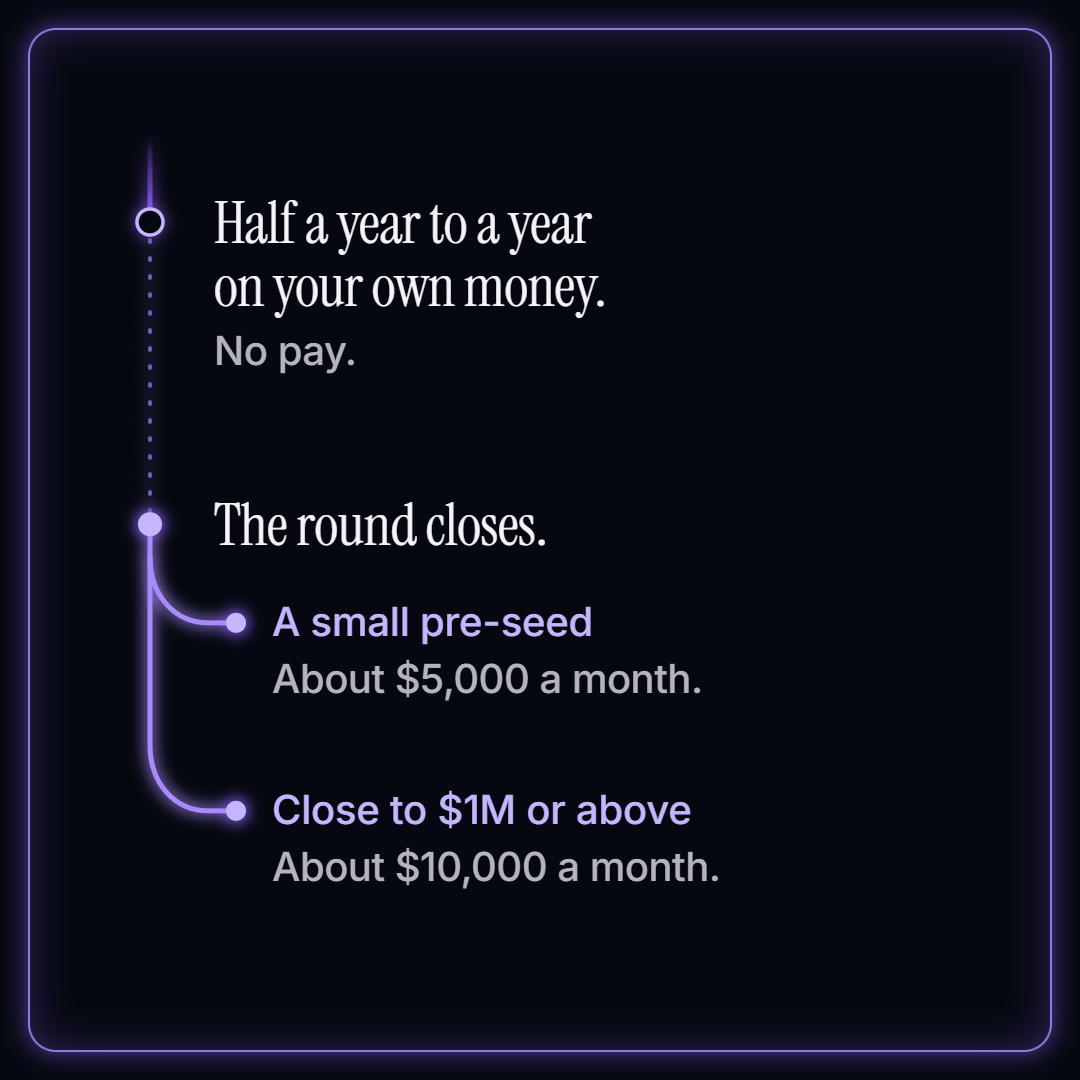
From what I see, it's about $5,000 a month on a small pre-seed and about $10,000 once the round is close to $1M or above. That's absolutely normal. It often comes after half a year or a year on your own money, so nobody is suddenly balling on it.
To check it, say you raise $1M to prove the next thing over 18 months. At $10,000 a month, your pay as the main founder is $180,000, 18% of the round. Add two more people full time, three freelancers and some infrastructure. If it fits into 18 months, it's easy to defend in front of a lead.
"this round proves [the one thing] by [when]. founder pay is $[x] a month, [z]% of the round. the rest goes to [what else it takes to prove it]."
If you raise from local VCs for a smaller market, like Africa or Poland, $10,000 a month looks strange. You'll raise less at a lower valuation, so the pay comes down too, and that's how it should be.
Published seed numbers: €70,000 to €100,000 a year for most European founders (Point Nine, 2023), and about $153,000 for a US CEO (Kruze, 2026).
I'd be very careful with paying yourself from the first cheque in the round just because it's there. That can spoil the round.
When should you quit your job to work on your startup
As late as you can, or when it's working so well that you can't do both.
If you're short of money, a job still comes before debt, as How to raise your first VC round when your dad doesn't work at a VC says.
If you quit before you have repeatable revenue or a closed round, have at least 12 months of savings, at your average monthly spending over the last three months. Be conservative: quitting three months too late is better than half a year too early, especially when someone depends on you.
When founders I see have work on the side, it's mostly consulting, part-time work or contract development, which is fine, because it's roughly the same work. If a job really gets in the way, you'll see it before a fund asks.
At the very first stage, an investor knows you have no money and may still have a job, and that's normal for them. If you're raising $10M and still need a job to cover your own $5,000 a month, I'd ask what you're doing.
What if co-founders don't have the same savings
Co-founders should know where each other stands with money.
If one of you lives off savings or covers company costs, that person in a sense puts more money in, so more shares or different vesting is normal. Agree on it up front, and you can put it in your founders' agreement.
"while it's still just us, let's write down what each of us puts in: savings, what each of us covers, hours a week. and what that means for shares."
If one of you works less, puts in less and won't change that, that person shouldn't get the same shares. It's brutal, but that's how it works.
What investors look for in founder salaries
When I invest, I check whether founders pay themselves too much. I have nothing against them paying themselves.
On a $500,000 pre-seed, three founders at $15,000 each cost $45,000 a month, and their salaries alone use up the round in about 11 months. At $5,000 each, it would last almost three years.
I also look at where the rest goes. Sometimes a founding engineer earns far more than he should, just because he's been there from the start, and that doesn't make sense to me.
Jenny Fielding of Everywhere Ventures told TechCrunch that $85,000 to $125,000 a year is reasonable at pre-seed, and she ended a deal where the founder paid himself $300,000.