 Horus
Why did your competitor raise more than you
They raised three times more, and you think your product is better than theirs.
In short
Find out what your competitor had that you don't and what they raised for, keep the comparison out of your pitch, and let the investor see on their own what your round bets on.
Find out what your competitor had that you don't and what they raised for, and keep the comparison out of your pitch. Name the bet you're raising for. Then let the investor see on their own that if it works, you're ahead of the market.
Founders put it like this: "we're better than them and they raised 3x what we struggle to raise". I don't buy it. If raising more means being better, they're just the stronger team. And if you say it to an investor, they'll measure you against a team that already got funded.
Is your competitor better because they raised more
Once you start asking who's better, you'll always conclude your competitor is worse.
You'll hear that they raised on contacts and CVs, and I half agree, because this early there's no real way to tell which one is the better company. Early rounds can be irrational. A lot of it runs on vibe.
But often it's also just how you see it. You'll have a better feeling about your own product than about anyone else's, and you'll tell yourself "this is how it's done today, and we do it better". So the question of who's better doesn't help you look at your own project or tell its story.
Many founders still want so badly to shit on the other team, because they think it's cool. They're looking at that team from a different POV than the investor's, and they can be wrong. They lose out, and they look worse to investors too.
If you say the other team raised on someone's network, people might as well say the same about your round when it's announced.
You'll also hear that teams like that raise a lot of money and never ship anything meaningful. People notice it more when a team that raised a lot loses. Lots of teams that nobody talks about raise little or nothing, and end at exactly the same zero as teams that raised a lot.
What to ask about your competitor's round
If I were you, I'd ask what your competitor had that you don't, even if it's only how the funds saw them.
Try to understand what you're missing, even when you think you're at the same level. Typing "hi chatgpt, tell me how this project compares to ours and where we're better" won't show you that.
What you're missing might exist only in the eyes of the funds or the market. It's about perceived value. Maybe it's the background they have and you don't. Maybe investors already knew them, as in How to raise your first VC round when your dad doesn't work at a VC.
Teams set out to raise different amounts, and the goals, the ambition and how they think about valuation can just be different. So ask what they raised that round for. Was it paid user acquisition, R&D, or something else?
A lot of founders skip that question about their own round. A round makes the most sense when it tests a bet off the back of something you already have, as I argued in The reason you're raising. Once you know what each round is for, you'll see whether comparing your round to theirs makes sense at all.
People also look a bit too much at the round a competitor announces. From what I've seen, a valuation gets announced when it's high, as I wrote in What valuation should you raise at.
The valuations inside one round can differ, too. I usually see only the highest cap announced, so you don't know what the lowest one was.
Does a funded competitor make it easier to raise
A competitor's round shows VCs are looking at your space, but it doesn't mean the money is really there for you.
Everyone knows that. Their round sets a precedent, and that's fine. Sure, I get that FOMO plays a part too. But every fund has slightly different interests, and different LPs who can push it in different directions. Keep that in mind.
Answering "why now" with some form of "other teams in our space are raising" is nuts. That's literally saying "other people are raising money, so we should too".
Should you compare yourself to competitors when pitching investors
The moment you say you're better than your competitor, people start measuring you against them, and your gaps show.
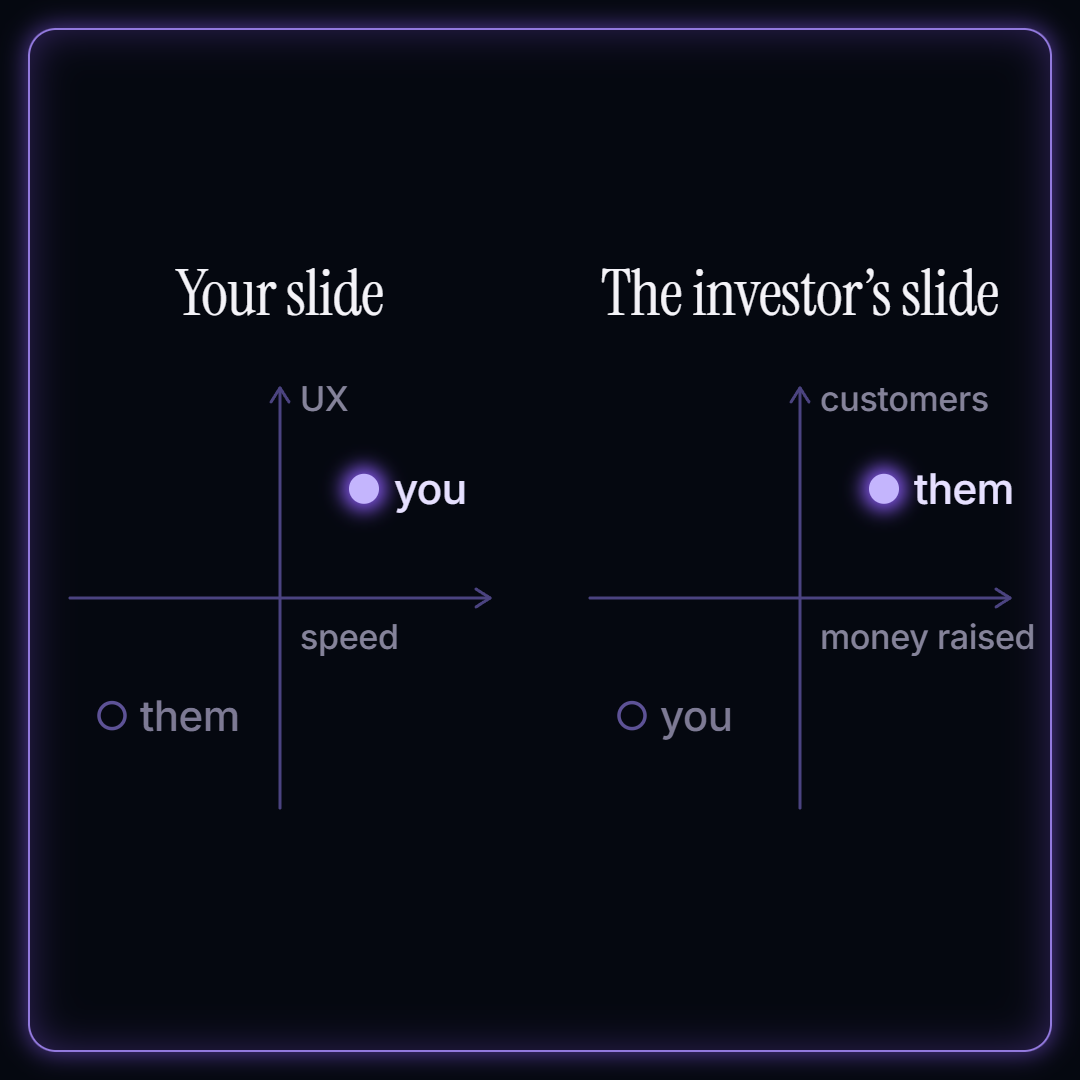
I'm against comparing yourself like that at all. My favourite is when someone raised a big round, and you're sure their product is worse than yours. So you put yourself in the top right corner of the map on your competition slide. It's supposed to sound great. But mostly you don't know what their product grew out of.
You get measured against a team that looks really great, all over the media, with all those VCs behind it. You don't have that background, and you don't have that much money, at least not yet. Most founders who push the comparison have far smaller resources.
It's like a boxing fan who hits the bag for an hour once every week or two. Then he goes to a UFC event and says he actually fights better than the UFC fighter. And he's never fought with all those cameras on him. Sorry, but to me that's aura loss.
Saying "they raised this much and they do it a bit worse" also admits you're building on their back. Your foundation is what someone else already built and raised.
Say there's a brand everyone in your market knows, and you build its 2.0, 15% faster and 10% cheaper. You tell people they're the big name, but you're better because of this and that. Nobody's going to care about you, because they're 50 million times bigger than you.
Why would a VC fund your competitor instead of you
Compare yourself to a competitor that already has customers, and you might talk the investor into backing them.
Say they're making money and you're not. You don't have a product live yet, and they have 500 customers. Then the investor thinks "why am i talking to you? maybe you'll convince me to invest in your competitor, since they already made it".
VCs call that kingmaking. The big money goes to the team that already looks like the winner, so it can win. Even at Series A, startups worldwide raised at least 114 rounds of $100 million or more in 2026 by late September, most of them in AI. Crunchbase counted them. It says investors may be backing the teams that look like early leaders, because a pricey share of a winner still beats a discounted share of a team that falls behind.
A competitor with 500 customers can most likely build your thing itself, faster and better than you. And it already has loads of customers to sell it to. That's a shitty frame to put yourself in.
Maybe it's you and your buddy with no money, and you've got it into your heads that you built a better product. It most likely isn't better.
It can be better in its assumptions and its ambition. But sometimes there are reasons why nobody did it your way, or someone's about to do it, and you don't know that either. You don't know, and you keep trashing the other team anyway. What for?
How to pitch when your competitor raised more
Best of all is when the person you're talking to notices on their own that you're ahead of the market.
When I look at the founders who tell the best story and are best to talk to, I see people who know their own limits. And you don't hear them whining "but we're better here".
That line is just your ego. You can be dead sure you're better. It still gives you nothing in the pitch.
The investor might think "wow, these people really are two steps ahead of today's market". If you're intentional in your conversations with VCs, and the investor understands what you're talking about, they'll get there on their own. It's like selling people an idea. You want them to reach your conclusion themselves.
Or the investor might see that if this round comes together, it funds a bet on the future, off the back of what you already have. If the bet works, you're suddenly a few steps or a few years ahead of the market. That bet is worth focusing on. It also gets you out of comparing yourself to your competitor.
What to say when a VC asks about your competitor
When a VC asks about your competitor, answer from your customer's side.
If you say "we built it from scratch, it's awesome, it works better", those are only your words, and nobody gives a shit about them. Your product can be way better technically, but if people don't use it, that means nothing.
Same with "they're slow, and our UX is amazing". I've seen that kind of UX fifty times. It's only better in your opinion.
The competition is usually the old way versus your way. So say what people use today and why they switch to you, in their words. On a first call it's the same kind of line, as in What stands between a good VC call and money in the bank.
"people use [x] and [y] today, and they're switching to us because [z]."
"people we talked to who used [competitor] told us ours is better, because [this] and [that]."
If you don't have those users yet, sorry. You'll have to check for yourself what got funded on your competitor's side, and see the real differences between their product and yours.
It's also a matter of research, and understanding how teams like that raise. Some founders shrug at it: "how am i supposed to know what VCs look at?" Then fucking find out. If you're telling me you're that good, you understand this market so well and you've spent 15 years in it, you can probably spend 15 hours in total on research like this.